



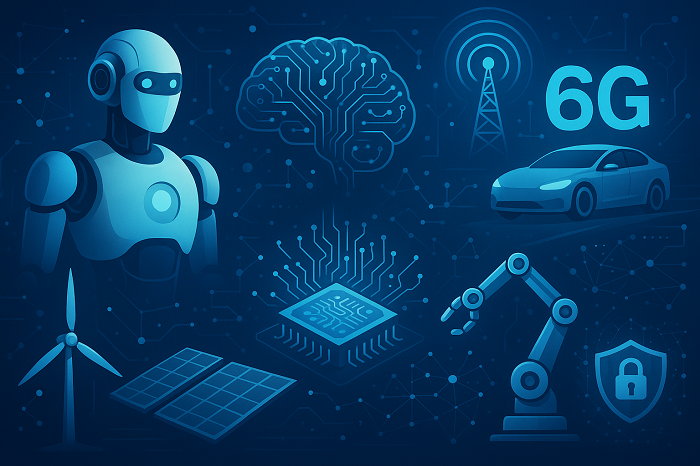
Technology continues to redefine the way we live, work, and interact with the world around us. Every year, new advancements emerge that disrupt industries, create opportunities, and push society toward the future. As we step into 2025, innovation is accelerating faster than ever, fueled by artificial intelligence, sustainable solutions, and an increasingly connected digital landscape. To stay ahead, businesses and individuals need to understand the major trends driving change. In this article, we explore the top 10 tech trends shaping the future in 2025, providing insights into how they are transforming industries and everyday life.
1. Artificial Intelligence Everywhere
Artificial Intelligence is no longer a futuristic concept, it has become a fundamental driver of technology across sectors. In 2025, AI is powering everything from healthcare diagnostics to personalized shopping experiences. Generative AI is revolutionizing content creation, while predictive AI enhances decision-making in industries such as finance, logistics, and education. AI assistants are becoming more intuitive, enabling seamless human-computer interactions. The increasing accessibility of AI tools means that even small businesses can now leverage this technology to compete with larger enterprises.
2. The Rise of Quantum Computing
Quantum computing is moving from research labs into real-world applications in 2025. With the ability to perform calculations far beyond the capacity of traditional computers, quantum systems are unlocking breakthroughs in fields such as pharmaceuticals, climate modeling, and financial optimization. Major tech companies are investing heavily in making quantum computing more practical and scalable. While still in its early stages, the impact of quantum technology promises to be transformative, offering solutions to problems previously thought unsolvable.
3. Next-Generation Connectivity with 6G
After the widespread adoption of 5G, the world is preparing for the rollout of 6G networks by the end of this decade. In 2025, early trials and pilot projects are already showcasing speeds up to 100 times faster than 5G. This next-generation connectivity will enable immersive experiences in virtual and augmented reality, support fully autonomous vehicles, and enhance the Internet of Things (IoT) ecosystem. Businesses that prepare for this shift now will be better positioned to harness the advantages of hyperconnectivity in the near future.
4. Sustainable Technology Solutions
As climate change continues to be a global challenge, 2025 marks a year where green technology is at the forefront of innovation. From renewable energy solutions to energy-efficient data centers, companies are embracing sustainability as both a necessity and a competitive advantage. Carbon capture technologies, biodegradable materials, and eco-friendly electronics are gaining traction. Consumers are increasingly demanding sustainable products, pushing organizations to integrate environmental responsibility into their technology roadmaps.
5. The Expansion of the Metaverse
The metaverse, once a buzzword, is maturing into a fully functional digital economy in 2025. Virtual worlds are no longer limited to gaming but extend into education, healthcare, and workplace collaboration. Companies are building immersive environments where employees can interact, learn, and innovate without geographical constraints. Digital ownership through NFTs and blockchain continues to support this virtual economy. The metaverse is evolving into an extension of our daily lives, offering limitless opportunities for businesses and individuals alike.
6. Autonomous and Electric Mobility
The transportation industry is undergoing rapid transformation in 2025 with the rise of autonomous vehicles and electric mobility. Self-driving cars are becoming more reliable and widely accepted, while electric vehicles dominate new car sales across multiple markets. Smart infrastructure, powered by AI and IoT, supports safer and more efficient mobility systems. These advancements not only reduce emissions but also reshape urban planning, logistics, and the way we commute.
7. Cybersecurity in the Age of AI
With digital transformation accelerating, cybersecurity remains a top priority in 2025. Cyber threats are becoming more sophisticated, driven by AI-powered hacking tools. To counter this, organizations are adopting advanced cybersecurity strategies that leverage machine learning for threat detection and real-time response. Zero-trust architecture is now a standard, ensuring that networks remain secure against both internal and external risks. Protecting digital identities and safeguarding sensitive data are essential for maintaining trust in a connected world.
8. Biotechnology and Human Enhancement
2025 is witnessing remarkable progress in biotechnology, blending technology with biology to improve human health and capabilities. Innovations include AI-driven drug discovery, personalized gene therapies, and wearable devices that monitor health in real time. Human augmentation, such as brain-computer interfaces and prosthetics powered by AI, is expanding the possibilities of human potential. These developments hold the promise of longer, healthier lives and could redefine what it means to be human in the digital age.
9. Robotics and Automation at Scale
Robotics is no longer confined to factories. In 2025, automation is transforming industries from agriculture to healthcare. Robots are being deployed in warehouses, hospitals, and even households, handling tasks ranging from surgery assistance to home cleaning. The integration of AI with robotics makes these machines smarter and more adaptable. This trend not only enhances productivity but also addresses labor shortages in critical sectors, creating new opportunities for economic growth.
10. Edge Computing and the Internet of Things
As more devices connect to the internet, edge computing is becoming a critical enabler in 2025. By processing data closer to where it is generated, edge computing reduces latency and enhances efficiency. This is particularly vital for applications like autonomous driving, smart cities, and industrial IoT. Combined with advancements in sensors and connectivity, IoT ecosystems are expanding rapidly, creating intelligent environments that respond in real time to human needs.
Conclusion
The year 2025 is a milestone in technological evolution, marked by innovations that are reshaping industries and daily life. From the power of artificial intelligence to the sustainability of green technologies, the future is being defined by the convergence of multiple trends. Understanding and adapting to these changes will be crucial for businesses, governments, and individuals who want to stay relevant and competitive. The key lies not just in adopting technology but in strategically integrating it into every aspect of society. For those who embrace these top 10 tech trends, the future holds limitless possibilities.
Frequently Asked Questions on Tech Trends in 2025
Q1. What is the most influential tech trend in 2025?
Answer. Artificial Intelligence remains the most influential trend, driving advancements across industries and enabling smarter decision-making.
Q2. How will 6G impact everyday life?
Answer. 6G will offer ultra-fast connectivity, enabling real-time immersive experiences, supporting autonomous vehicles, and powering massive IoT systems.
Q3. Are quantum computers available to the public in 2025?
Answer. Quantum computers are still in development stages, but select industries such as pharmaceuticals and finance are beginning to test practical applications.
Q4. Why is sustainable technology important in 2025?
Answer. Sustainable technology addresses environmental challenges while meeting consumer demand for eco-friendly solutions, making it vital for long-term growth.
Q5. What industries will benefit most from the metaverse?
Answer. Education, healthcare, and corporate collaboration are among the industries gaining the most from metaverse adoption in 2025.







Comments are closed