




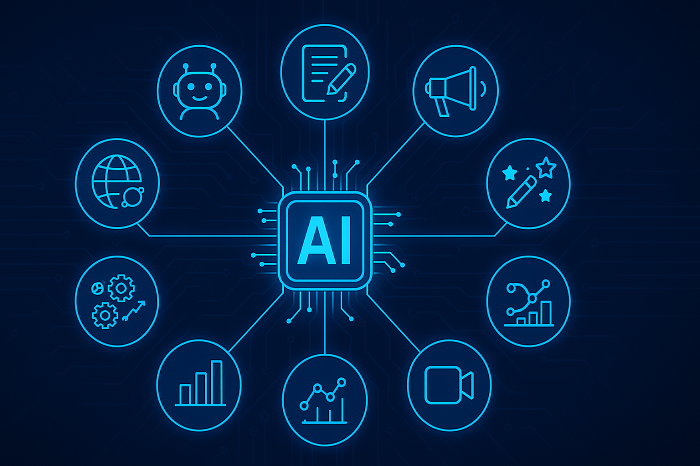
Artificial Intelligence has rapidly become an essential driver of growth, efficiency, and innovation in the business world. From automating repetitive tasks to providing deep insights into customer behavior, AI tools are transforming how businesses operate. For startups, small businesses, and even large enterprises, adopting the right AI tools can mean the difference between staying ahead of the competition or falling behind. In this article, we will explore the top 10 AI tools every business should use, covering how each one enhances productivity, decision-making, and customer satisfaction.
Why Businesses Need AI Tools
AI is no longer just a buzzword, it is a necessity for businesses looking to streamline operations and scale effectively. Whether it is data analysis, marketing automation, sales forecasting, or customer support, AI brings unmatched speed and accuracy. Businesses that leverage AI tools benefit from reduced operational costs, improved decision-making, and enhanced customer engagement. More importantly, these tools allow teams to focus on strategic growth while machines handle repetitive, data-heavy tasks.
Top 10 AI Tools Every Business Should Use
1. ChatGPT for Customer Support and Content Creation
One of the most widely adopted AI platforms is ChatGPT, which businesses use for conversational customer support, content generation, and task automation. It helps companies provide instant, personalized responses to customer queries, create marketing content, and draft professional emails. This reduces response time, increases customer satisfaction, and boosts overall productivity.
2. Jasper AI for Marketing and Copywriting
Jasper AI is a specialized content creation tool that assists marketers in writing persuasive copy, blog articles, ad campaigns, and product descriptions. By analyzing tone and audience behavior, Jasper ensures the content is engaging and conversion-focused. Businesses save time on copywriting while maintaining brand voice consistency across channels.
3. Grammarly Business for Communication Excellence
Clear communication is vital for any business, and Grammarly Business leverages AI to help teams write with clarity and confidence. It checks grammar, tone, and readability in real time, ensuring emails, proposals, and marketing materials are error-free and professional. With collaborative features, it ensures all team members maintain a consistent style.
4. HubSpot AI for Sales and Marketing Automation
HubSpot has integrated AI into its CRM platform to improve lead scoring, automate email campaigns, and optimize marketing strategies. The AI-driven insights help sales teams prioritize prospects while marketing teams can design highly personalized campaigns. This tool enables businesses to convert leads more effectively and drive revenue growth.
5. Salesforce Einstein for Smarter CRM
Salesforce Einstein is an AI-powered extension of the Salesforce CRM that offers predictive analytics, customer insights, and sales forecasting. It analyzes data to recommend next best actions, helping businesses nurture relationships and close deals faster. Companies that adopt Salesforce Einstein benefit from a more proactive approach to customer relationship management.
6. Canva AI for Creative Design
Design is crucial for branding and marketing, but not all businesses can afford in-house designers. Canva AI provides design assistance by generating creative templates, suggesting layouts, and even creating AI-generated visuals. With its intuitive interface, even non-designers can create professional-quality graphics, presentations, and social media content.
7. Hootsuite Insights powered by AI for Social Media Management
Social media plays a critical role in brand awareness and customer engagement. Hootsuite Insights uses AI to analyze audience sentiment, track trends, and optimize posting schedules. Businesses can measure campaign effectiveness in real time and make data-driven decisions to improve their social media strategy.
8. Zapier AI for Workflow Automation
Zapier is well known for connecting different apps and automating workflows, and with AI integration, it becomes even more powerful. Businesses can create smart workflows that learn from patterns, reducing manual work and ensuring seamless communication between software tools. This improves efficiency and reduces human error.
9. Tableau with AI for Data Visualization
Businesses generate large volumes of data, but raw data is meaningless without proper visualization. Tableau uses AI to help businesses interpret data through smart dashboards, predictive analytics, and automated insights. This enables managers to spot trends, make informed decisions, and align strategies with real-time business intelligence.
10. Zoom AI Companion for Smarter Collaboration
With the rise of remote and hybrid work, Zoom has added an AI Companion that enhances collaboration by generating meeting summaries, transcriptions, and even suggested follow-up tasks. This ensures that teams stay aligned, meetings are more productive, and no critical information is lost in communication.
How AI Tools Transform Businesses
These AI tools collectively improve efficiency, accuracy, and growth potential. Customer service becomes more responsive, marketing campaigns become more personalized, sales pipelines become more predictable, and decision-making becomes data-driven. In short, AI empowers businesses to do more with fewer resources while keeping customers at the center of operations.
Conclusion
The business landscape is evolving rapidly, and AI tools are no longer optional, they are essential for success. By integrating AI into different functions such as sales, marketing, customer service, and operations, businesses can gain a competitive edge, reduce costs, and scale effectively. The top 10 AI tools we discussed are reliable, widely used, and proven to deliver results. For any business aiming to thrive in today’s digital economy, embracing AI is the smartest investment.
Frequently Asked Questions (FAQs)
Q1. What are AI tools in business?
Answer. AI tools in business are software applications powered by artificial intelligence that help automate tasks, analyze data, and improve decision-making across different business functions.
Q2. How do AI tools benefit small businesses?
Answer. Small businesses benefit by saving time and costs, improving customer service, creating professional content, and making smarter business decisions with AI-driven insights.
Q3. Are AI tools expensive for startups?
Answer. Many AI tools offer affordable pricing models, including free versions or scalable plans, making them accessible even for startups and small businesses.
Q4. Which AI tool is best for marketing?
Answer. Jasper AI and HubSpot are among the best AI tools for marketing because they specialize in content creation and campaign automation.
Q5. Can AI replace human employees?
Answer. AI tools are designed to assist humans, not replace them. They handle repetitive and data-heavy tasks, allowing employees to focus on strategy, creativity, and relationship building.
Q6. What is the future of AI in business?
Answer. The future of AI in business involves deeper personalization, advanced predictive analytics, and seamless automation across all business processes, helping companies scale faster and smarter.


Comments are closed