



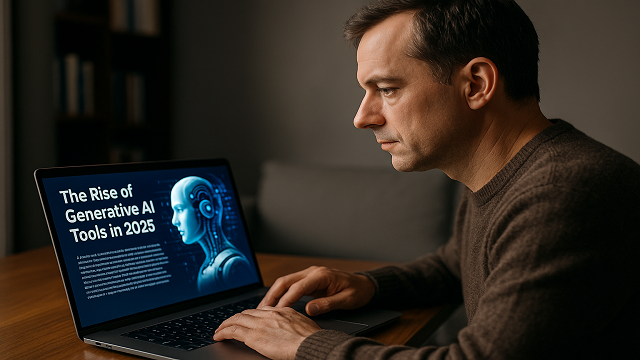
In 2025, the world of technology feels like it has entered a new era. The conversation around artificial intelligence is no longer limited to research papers or experimental labs. Generative AI has gone mainstream. From workplaces and classrooms to design studios and personal devices, AI tools are not only part of daily life but are also reshaping the way humans think, create, and collaborate.
This article dives deep into the evolution of generative AI, the industries being disrupted, the challenges ahead, and why 2025 marks a turning point in the way we look at machine-driven creativity.
The Evolution of Generative AI
A few years ago, AI was mostly about automation – helping companies complete repetitive tasks faster. But generative AI introduced something different. It brought machines into the creative process. AI can now write essays, design logos, compose music, generate code, and even simulate human conversation at a near-professional level.
By 2025, these systems have grown dramatically more advanced. What once required expensive computing power is now accessible through cloud platforms and consumer apps. The democratization of generative AI means that anyone with an internet connection can harness machine creativity. This accessibility is what makes 2025 so different from the earlier stages of AI adoption.
Generative AI in Creative Industries
One of the most striking impacts of AI has been on creative fields. Writers use AI tools to generate drafts, brainstorm headlines, or even co-author full-length books. Musicians experiment with AI to compose new sounds, blending genres that humans might never think to combine. In film production, AI is being used to edit video, create special effects, and even script scenes.
Artists, once skeptical of digital intervention, are now collaborating with AI to build hybrid art forms. These creations spark debates: Is it still “art” if a machine helped? But most professionals agree that AI isn’t replacing artists. Instead, it is expanding their creative toolkit, giving them new ways to express ideas and test concepts.
Workplace Transformation
The corporate world has embraced generative AI as more than a novelty. In 2025, it has become a productivity powerhouse. Companies use AI to generate reports, analyze customer feedback, automate presentations, and even provide real-time language translation in meetings.
For employees, AI serves as a digital assistant that reduces time spent on routine tasks. Instead of writing long emails from scratch, workers rely on AI suggestions. Instead of staring at a blank slide deck, they begin with AI-generated templates. The workplace of 2025 is faster, more adaptive, and more reliant on AI than ever before.
Yet, this comes with challenges. Many workers worry about job displacement. While AI takes over repetitive functions, the demand for human oversight and creativity has increased. The balance between automation and human contribution remains a hot debate.
Education and Generative AI
Classrooms are changing too. Generative AI acts as both a teacher’s aide and a student’s guide. It helps explain complex subjects in simple terms, generates practice quizzes, and even provides personalized learning pathways for students.
In 2025, students are not only learning with AI but also learning about AI. Educational institutions emphasize digital literacy, ensuring that future generations understand how to responsibly use AI tools.
Some educators still raise concerns about plagiarism and overreliance on machine-generated answers. But with proper regulation and creative use, generative AI is proving to be more of an educational asset than a threat.
Healthcare and Generative AI
The healthcare sector has also witnessed major transformations. Doctors use AI to draft patient notes, analyze lab results, and simulate treatment plans. Generative AI assists in designing new molecules for drug development, dramatically reducing research time.
For patients, AI-driven apps provide personalized wellness advice, generate diet plans, and even simulate mental health conversations when human therapists are unavailable. While AI is not a replacement for professionals, it is increasingly becoming a supportive layer of healthcare delivery.
Ethical Concerns and Regulation
No discussion about AI is complete without addressing ethics. As generative AI grows more powerful, the risk of misuse increases. Deepfakes, misinformation, and copyright issues remain pressing concerns in 2025. Governments and tech companies are working to establish clearer rules and frameworks to regulate AI use.
Transparency has become a central demand. Users want to know when content is AI-generated. Creative professionals demand better copyright protections for original work. Regulators push for accountability when AI causes harm. The success of AI in 2025 is tied not only to its technical progress but also to how societies manage its risks.
Generative AI and Human Identity
One of the most fascinating debates of 2025 is philosophical: What does it mean to be human in a world where machines can imitate human creativity?
Generative AI has forced people to reflect on the nature of originality, creativity, and authorship. Some argue that AI simply recombines existing data, while human imagination remains unmatched. Others claim that AI-generated work can stand independently as “new” creation.
This debate is shaping culture, art, and even law. The conversation may never have a clear answer, but it highlights how deeply AI is influencing not just industries, but human thought itself.
The Road Ahead
Looking beyond 2025, generative AI is expected to grow even more integrated with daily life. Smarter voice assistants, AI-powered household robots, and personalized media streams are just the beginning. The potential for innovation is limitless, but so are the ethical and social challenges.
What remains certain is that AI will not fade into the background. It will continue to evolve as a visible partner in how we live, work, and imagine. For individuals, the challenge is to adapt without losing the human spark that technology cannot replicate. For companies, the challenge is to innovate responsibly. And for governments, the challenge is to regulate without stifling progress.
Conclusion
The rise of generative AI tools in 2025 represents more than just a technological trend. It is a cultural and social turning point. From art and education to healthcare and business, AI is no longer a background system, it is a collaborator, a challenger, and sometimes a competitor.
The coming years will decide whether humanity harnesses this power wisely. If managed responsibly, generative AI could become one of the greatest allies of human progress. If misused, it could become a source of confusion and conflict.





Comments are closed